 Part 11
Part 13
Part 11
Part 13
During the 1850s, nativism continued to rise in America, especially in the North, which had far higher immigration than the South. Despite its popularity, it wasn't fully adopted by the Democrats or the Whigs. Embracing nativism meant alienating foreign voters, making it a risky strategy. But when the Whig Party collapsed, it created a power vacuum. There was now room for a new major party to rise in opposition to the Democrats, and it wasn't immediately clear what that new party would be.
In New York City, people who were angry about immigration were forming nativist clubs to promote their ideas, one of which was called "The Order of the Star Spangled Banner". Its members were required to only vote for native-born citizens and Protestants, regardless of their political views. Any members who held political office themselves would remove Catholics and foreigners from positions of power. The order was also extremely secretive. When asked about it, its members always insisted that they knew nothing about it.
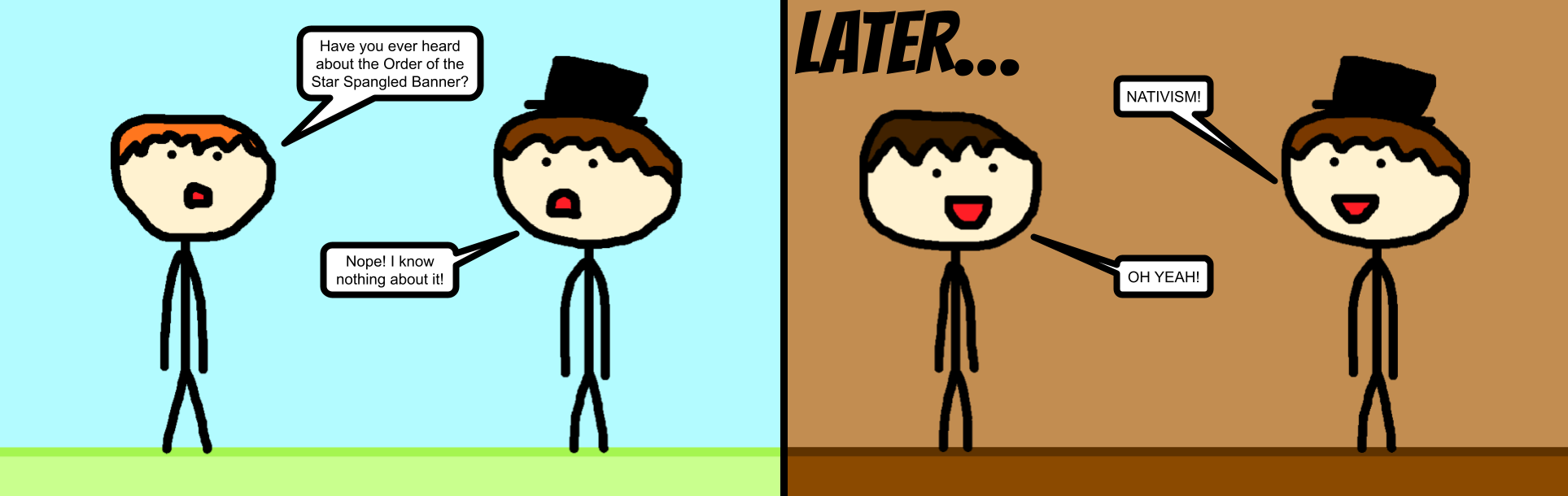
The order spread across the North, having branches in New Jersey, Massachusetts, Ohio, and even Connecticut. Eventually, the Order of the Star Spangled Banner morphed into a political party, the American Party. But it was soon dubbed the "Know-Nothing Party" due to its secretive nature.
Since nativism was such a popular cause in the North, the Know-Nothing Party seemed to have a chance at filling the power vacuum and becoming a large, national party that could oppose the Democrats. But it wasn't the only new party with a lot of potential.
In 1854, Stephen Douglas introduced a bill to create the territories of Kansas and Nebraska. Under the Missouri Compromise, both of these territories should have prohibited slavery, but the bill undid the Missouri Compromise and allowed both territories to vote on whether or not to have slavery. The Missouri Compromise had been established all the way back in 1820, and it banned slavery in almost all of the Louisiana Purchase land. The Whigs voted overwhelmingly against it, and almost half of Northern Democrats also opposed it. But due to its large Southern support, it passed anyway. Needless to say, Northerners were furious.
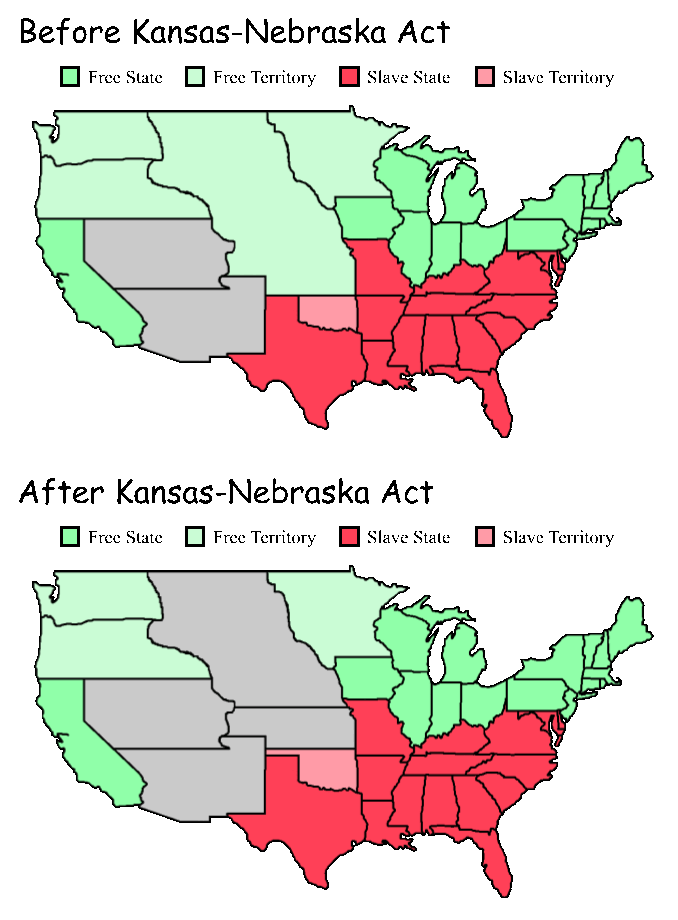
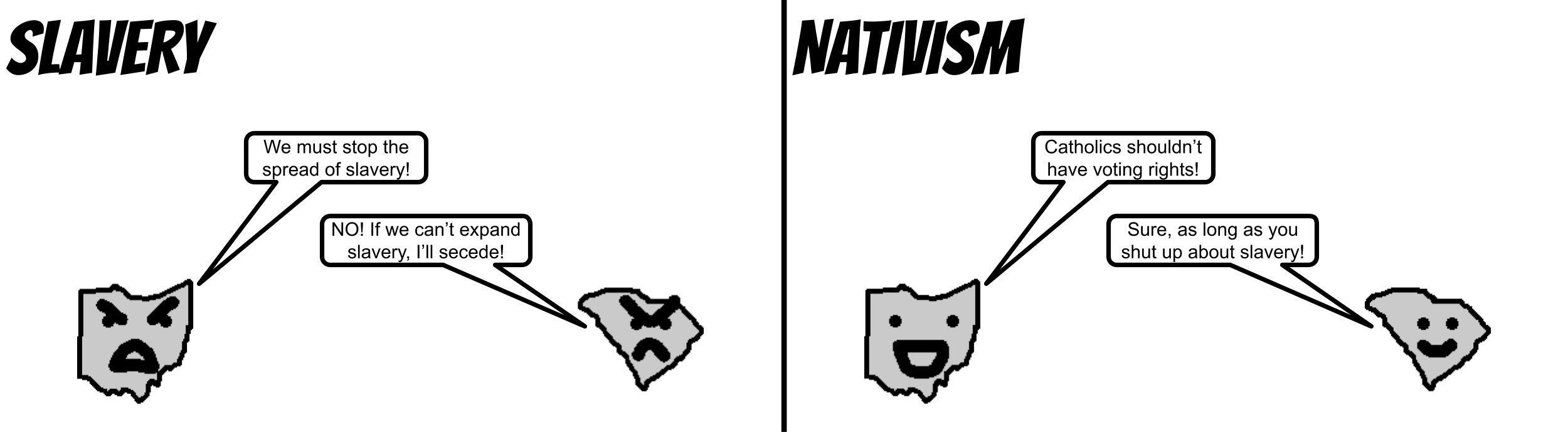
The Republican Party was soon formed to oppose the Kansas-Nebraska Act. Whereas the Whigs were always intensely divided over slavery, the Republicans overwhelmingly supported free soil. Like the Know-Nothings, the Republicans supported a cause that was very popular in the North, and they seemed to have a chance at filling the power vacuum created by the collapse of the Whigs. As people abandoned the Whig Party, they tended to join either the Know-Nothings or the Republicans. The split was messy and complicated, but in general, the radical Whigs joined the Republicans, whereas the moderate Whigs joined the Know-Nothings.
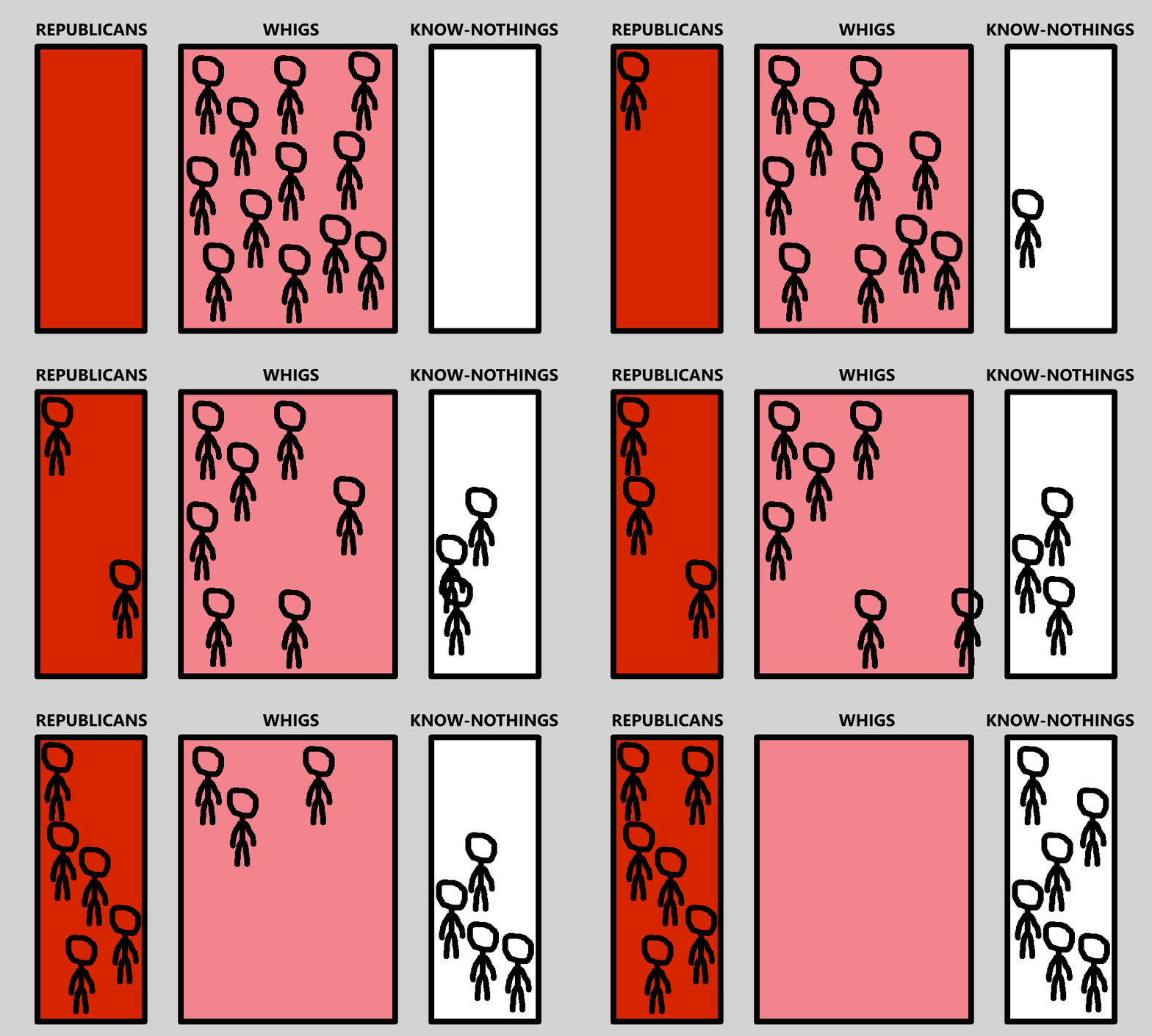
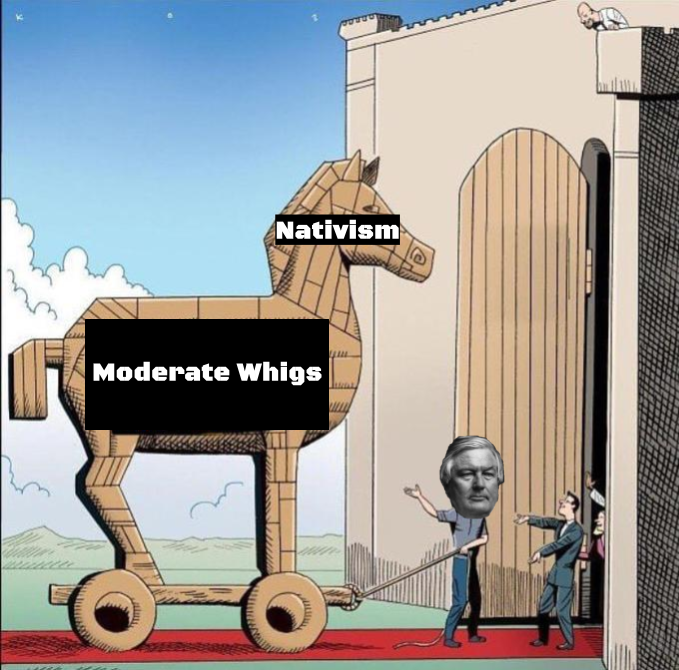
It may seem odd that moderate Whigs joined a nativist party. Although they had flirted with nativism in the past, it was never one of their main goals. The thing is, many of these new Know-Nothings didn't actually care about nativism. Similar to how many Anti-Masons exploited Anti-Masonism to get elected, former Whigs were trying to exploit nativism to do the same. They'd pretend to care about it since it was popular, but in reality, they wanted to hijack the party and shift its focus to the causes they actually supported.
As a moderate Whig, Fillmore arguably should have joined the Know-Nothings, but he was still grieving over the loss of his wife. He watched the Kansas-Nebraska debates from the sidelines, and he was disappointed to see the peace he had created being disrupted. About a year after the death of his wife, Fillmore lost his daughter as well. She was only 22.
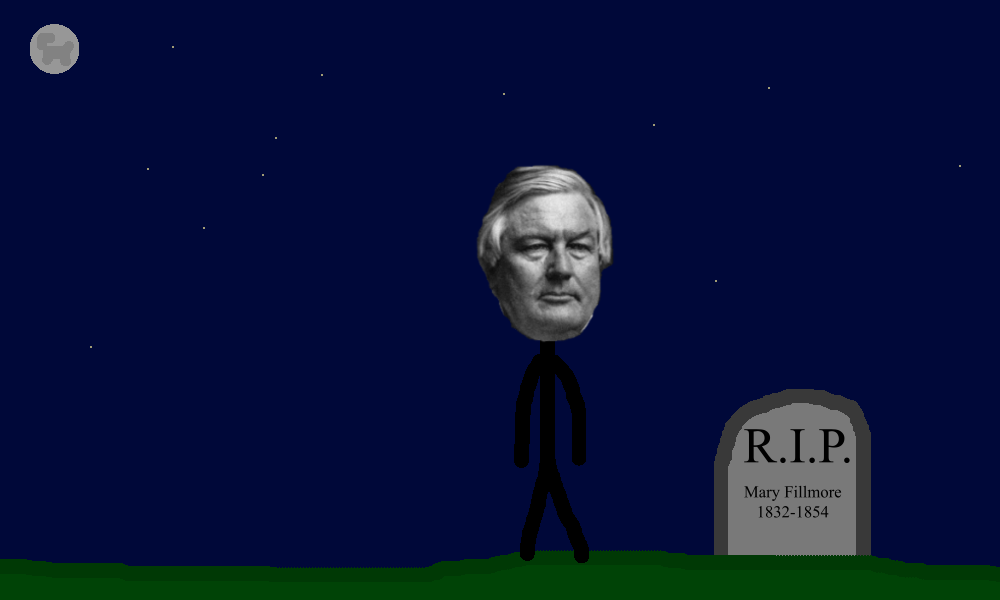
Trying to take his mind off his losses, Fillmore decided to (once again) come out of retirement and get back into politics. He thought about joining the Know-Nothings, but he wasn't certain. Meanwhile, he hated the Republicans.
Prior to the Republicans, both the Democrats and the Whigs could win in any region of the country. Sure, the Democrats generally did better in the South, and the Whigs generally did better in the North, but there were many Northern Democrats and Southern Whigs. Only a few states were completely loyal to one party. This changed with the Republicans. It was unthinkable for a Republican to win in any of the Southern states, which would never support a party that opposed the expansion of slavery. If the Republicans could win every Northern state, they could win a presidential election without any Southern support The South, scared about the end of slavery, would secede, leading to a civil war.
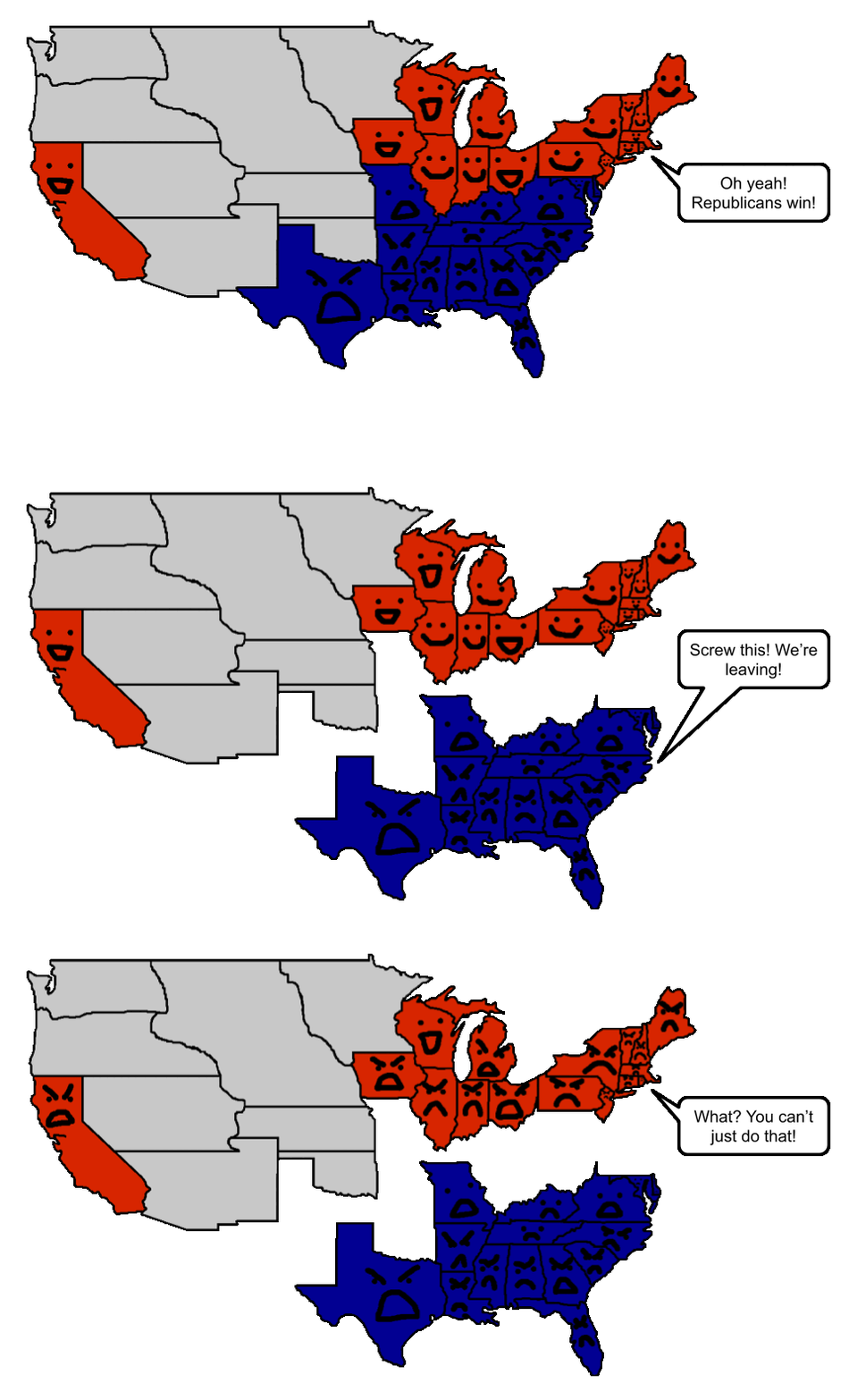
This was exactly what Fillmore, who believed in compromise and national unity at all costs, wanted to avoid. Thus, he viewed the Republicans as a bunch of dangerous rabble rousers. Meanwhile, he viewed the Know-Nothings more favorably. Whereas slavery was an inherently divisive issue, nativism was popular in the North and acceptable in the South. Even though he didn't care about nativism, he thought it had potential to unite the country. Still, he wasn't ready to join the Know-Nothings until they got clear election results. And soon, they did.
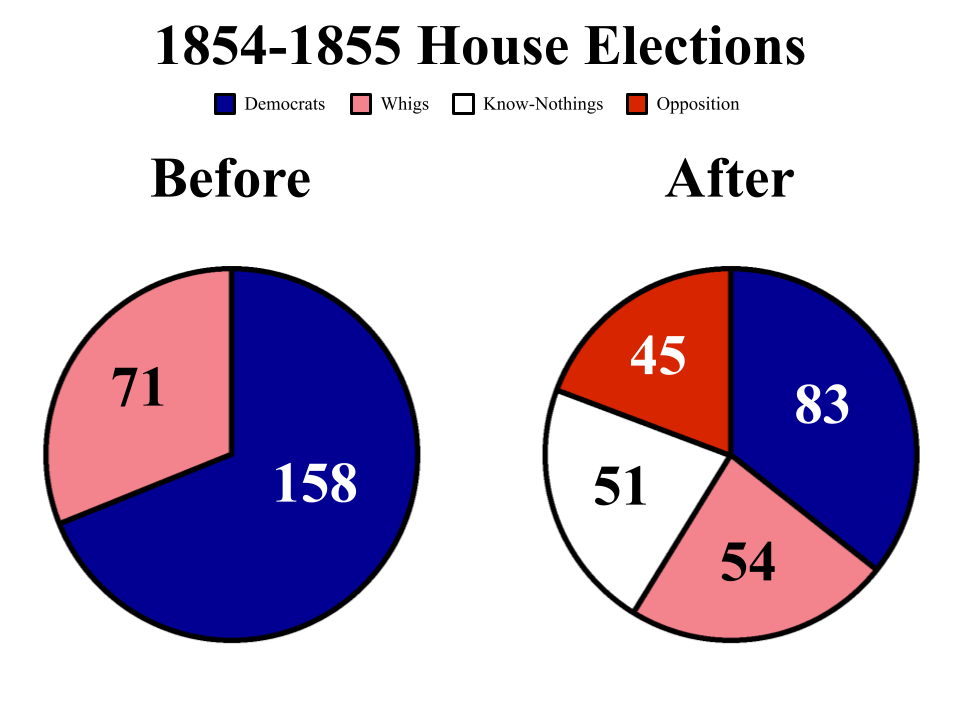
In the fall of 1854, Know-Nothing candidates ran in state and congressional elections. They did great, winning in Massachusetts, Delaware, and Pennsylvania. In congressional elections, the Democrats got annihilated by the Know-Nothings and Republicans. Seeing this, Fillmore finally took the plunge and joined the Know-Nothings.
From there, Fillmore hoped to become the Know-Nothing presidential candidate for the 1856 election. As a former president, it would have been pretty easy for him to get the nomination as long as he was sufficiently nativist. In late 1855, Isaac Newton, a leader in Philadelphia's nativist party, wrote to him asking about his views on nativism. Fillmore knew Newton was going to publish his reply, so he wrote knowing he'd be addressing the whole country.
He said that for a while, he'd been concerned about the influence of foreign voters in elections. He complained that native-born citizens were being overlooked. Although he felt the most oppressed people in Europe should be given asylum and equal protection of the law in America, holding office should be reserved for people who were actually raised in a free nation like America.
It was far from the most nativist message, and it shows how Fillmore's real goal was to appear nativist on the surface while actually focusing on national unity. He actually did a lot to emphasize protecting the rights of foreigners, but his reply was nativist enough for him to be accepted by the Know-Nothings.
With that settled, Fillmore was now very likely to be the Know-Nothing candidate for 1856. So he hightailed it to Europe, wanting to get away from all the chaos. During his time there, he drew many crowds, impressing many who thought of Americans as weird morons.
There were a few highlights of Fillmore's adventures in Europe. In London, he was offered a degree by the University of Oxford, but he turned it down since he feared that Oxford students would make fun of him. In France, his enemy Horace Greeley was in jail for debt, and Fillmore bailed him out. In Rome, he met the Pope, which is a strange decision for someone running under a party that's supposed to hate Catholics.
Meanwhile, back in America the Know-Nothings held their nominating convention in February of 1856. When deciding their platform, they ended up having a weak stance on slavery, advocating for popular sovereignty and refusing to push for the reinstatement of the Missouri Compromise. This resulted in many Northern delegates storming out of the convention. Many members of the anti-slavery wing of the party left to join the Republicans instead. With the radicals gone, the Know-Nothing Party was solidified as the party of the former moderate Whigs.
Fillmore's only competition for the presidential nomination was George Law, a former Democrat who was much more of an actual nativist than Fillmore. In the end, Fillmore won the nomination. Since he was a Northerner, and the Know-Nothings valued national unity, they knew they had to pick a Southerner as his running mate. They nominated Andrew Jackson Donelson, Andrew Jackson's nephew.
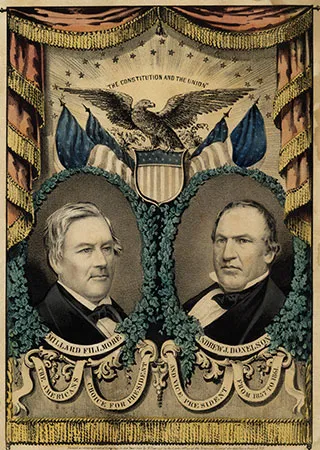
When he was nominated, Fillmore was still in Europe. The other two major parties wouldn't hold their conventions until June. Before then, some rather chaotic events ended up helping the Republicans.
After the Kansas-Nebraska Act was passed, Kansas Territory held an election to pick representatives for its legislature. Most residents of Kansas wanted it to be a free state. But Missourians were nervous about being surrounded by free states on three sides, so many of them flocked to Kansas to vote in the election before returning home. Because of these fraudulent votes, the pro-slavery side won. In response, the anti-slavery side formed its own government, and violence broke out in what became known as "Bleeding Kansas". President Pierce refused to acknowledge that the election had been fraudulent, and he fully supported the pro-slavery government.
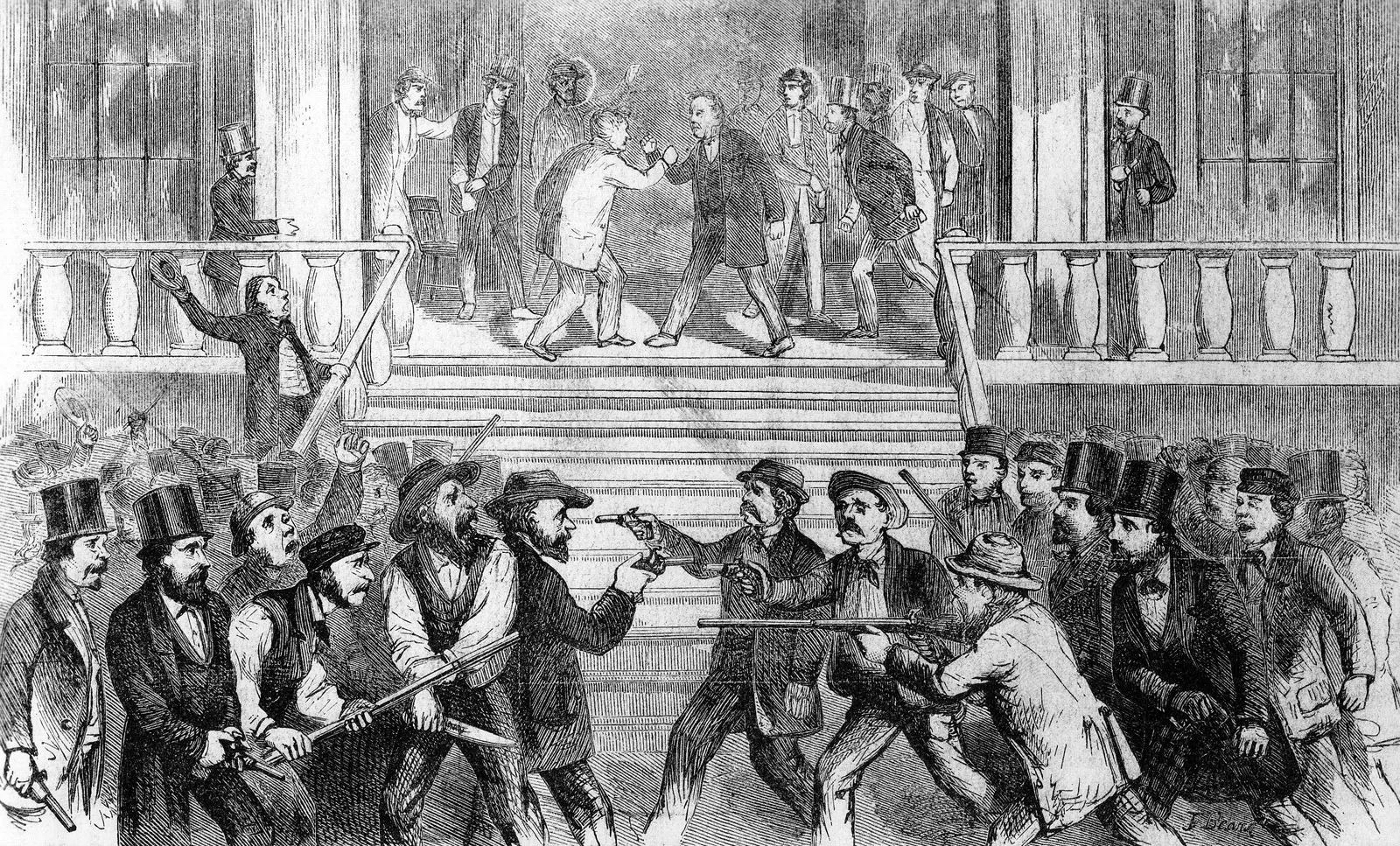
But Kansas wasn't the only thing bleeding in 1856. Charles Sumner, an abolitionist Senator, made a speech denouncing slavery and multiple Southern politicians. In response, Preston Brooks, a representative from South Carolina, snuck up behind him in the Senate chamber and caned the shit out of him, almost killing him. Quite concerningly, most Southerners supported Brooks, refusing to condemn the violence. Some even sent him new canes to thank him for what he did.
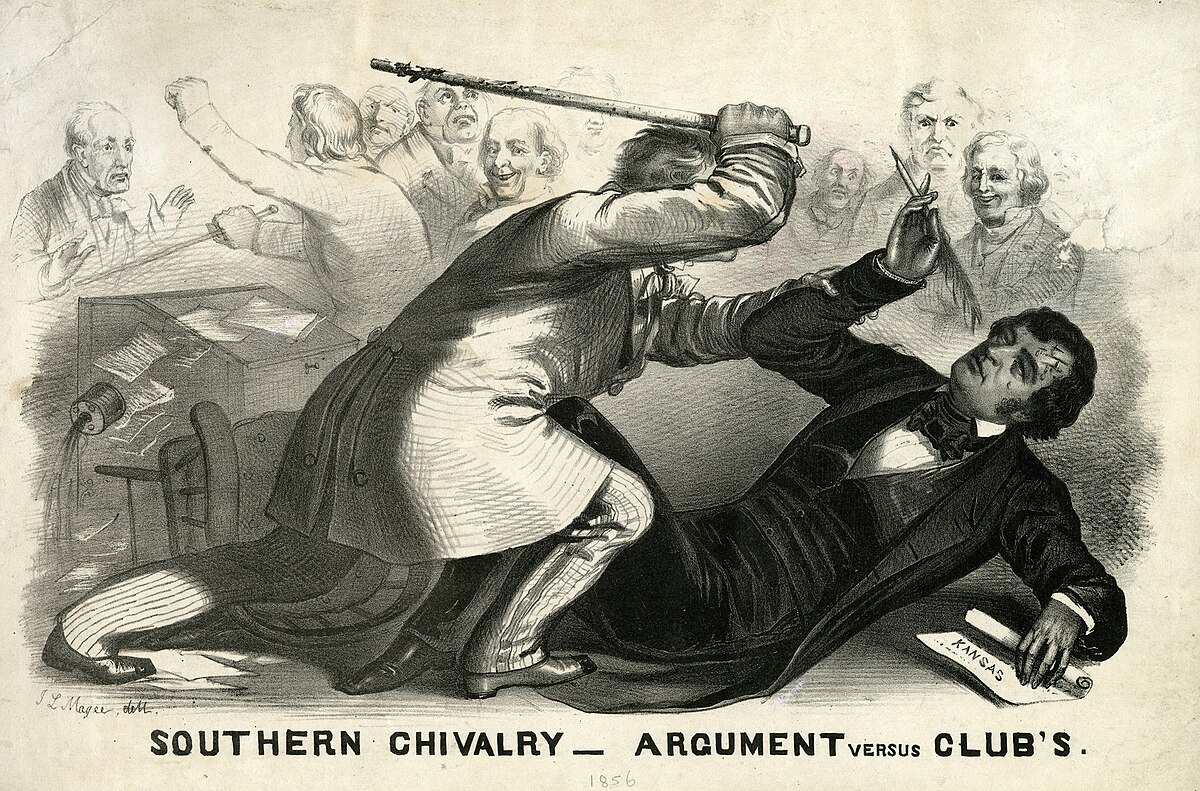
The Republican press used these stories to make the South look barbaric, corrupt, and violent. They did a great job at turning Northerners against the South and against slavery, but they were still a new party, so they were very poorly organized in some states. Weed and Seward thought it may be a good idea for Seward to try and become their nominee for president, but in the end, they were nervous that the Republicans could not win in 1856, so they decided to wait until 1860. Instead, John C. Fremont, a well-known explorer and former Senator, received the nomination. The Republicans rallied against slavery and polygamy in the territories. They used things like the Bleeding Kansas and the caning of Sumner to incite anger among Northern voters.
The Democrats were more vulnerable than they were in 1852, but they still thought they had a very good chance at winning the election. Although the Republicans were a clear threat, they were also very new, and they lacked any appeal outside of the North. However, they knew Pierce was an unpopular president in the North, so they instead nominated James Buchanan. The Democrats embraced popular sovereignty, and argued that if Fremont was elected, the South would secede, leading to civil war. They also argued that voting for Fillmore would hand the election to Fremont, so it was absolutely necessary to vote for Buchanan.
Finally, Fillmore and the Know-Nothings knew they had no chance of winning. Instead, they hoped to win enough states to stop either Buchanan or Fremont from getting a majority of electoral votes. This would throw the race into the House of Representatives, where anything could happen. Know-Nothings didn't have much popularity in the North due to their support of popular sovereignty. Instead, they did best in the upper South, where many feared disunion if Fremont or Buchanan won. The Know-Nothings framed themselves as the only party that could hold the country together. The Republicans were so radical that the South would secede if they won, and the Democrats were the ones who were threatening secession in the first place.
When Fillmore finally returned from Europe, he promised that he'd be fair to both the North and the South. He stumped the country and made 27 addresses, focusing primarily on the vulnerability of the Union and the potential for civil war. He spoke out against the Republican Party, arguing that the South would never accept a Republican and that Republicans were exaggerating the violence in Kansas. He only talked about nativism in three of his 27 speeches. Even when he did talk about it, he also said he was not hostile toward foreigners and was tolerant of all religions.
Fillmore tried his best, but as time passed, he lost more and more support in both the North and the South. Ever since Andrew Jackson became president, appealing to the masses was important, and the former moderate Whigs were much worse at that than the radicals. The Know-Nothings' earlier successes occurred because nativism was a popular cause, but now that they'd moderated on it, their appeal diminished significantly. The Republicans skillfully used Bleeding Kansas and Bleeding Sumner to anger Northerners. Meanwhile, the Know-Nothings primarily advocated for sectional peace, lacking the sensationalism of the Republicans.
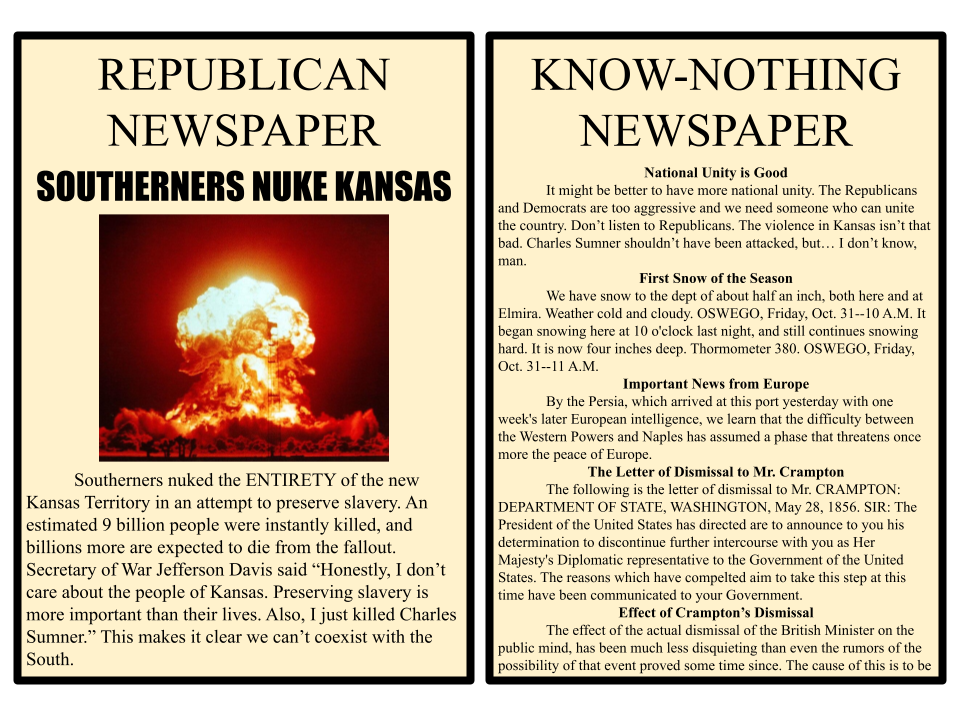
And the effectiveness of the Republicans didn't just hurt Fillmore in the North. It also hurt him in the South. Many people who wanted to support Fillmore were so scared of the Republicans that they voted Democrat, believing Buchanan was the only one who could beat Fremont.
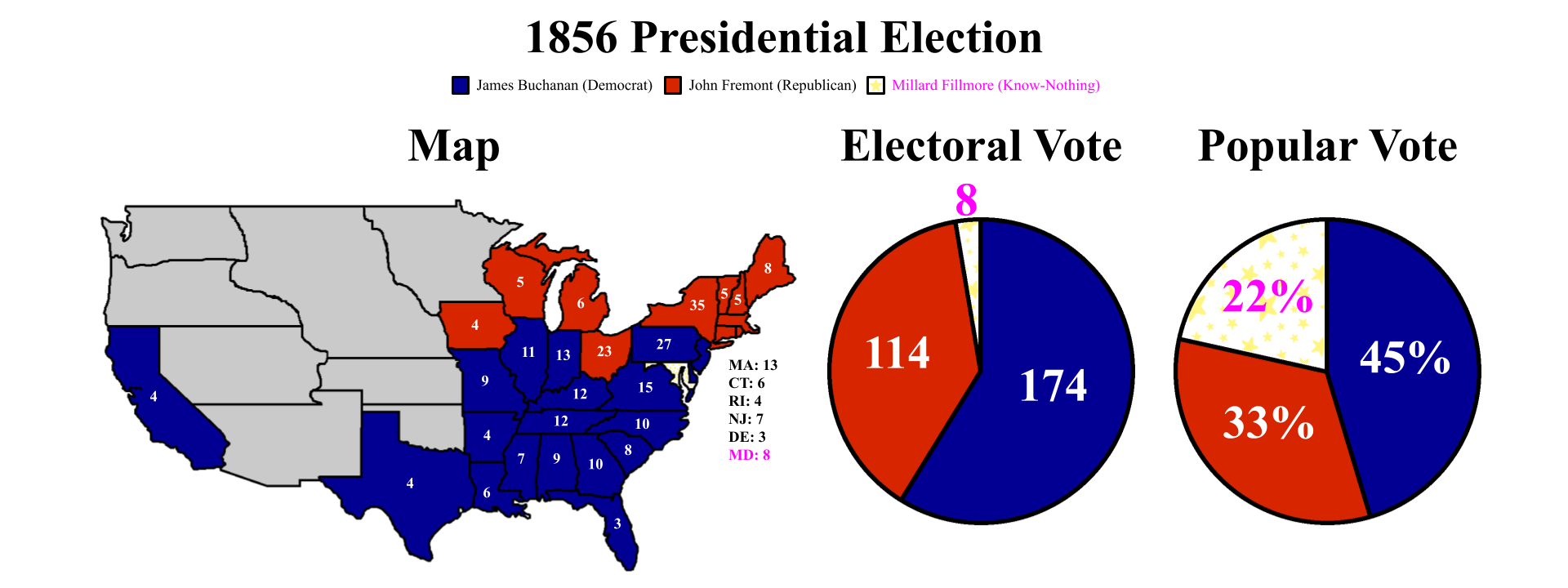
The Republicans had a strong showing, but Buchanan ultimately won the election by a wide margin. Buchanan managed to win a few free states and almost every slave state. Fillmore only won Maryland. Fremont won the remaining Northern states.
Though Fillmore only got 8 electoral votes, he got a large share of the popular vote, getting 13% of the vote in the North, and 44% in the South. He failed to achieve his goal of getting enough votes to stop Buchanan or Fremont from winning, but he came surprisingly close. Louisiana, Kentucky, and Tennessee almost went for Fillmore, and if all of them had, Buchanan would not have gotten a majority of electoral votes.
Although he was embarrassed, Fillmore was not surprised and expected to lose by a wide margin. After this, and I know this has happened a lot, Fillmore decided he wanted to retire from politics. He finally remarried. His new wife, Caroline, was rich, so they bought a mansion together. Many who visited Buffalo went to see him and his wife, and they were very hospitable. For the rest of his life, Fillmore would avoid holding political office and instead watched from the sidelines.
Part 11 Part 13