 Part 1
Part 3
Part 1
Part 3
We all know that when it comes to politics, the only two parties that have a shot at winning anything are the Democrats and the Republicans. It's been this way for over a hundred years, and it shows no signs of changing any time soon. But this wasn't always the case. When the United States first became an actual country, none of this was established yet. Parties were all over the place, and they were constantly falling apart. It would take decades for the two party system we have today to be established.
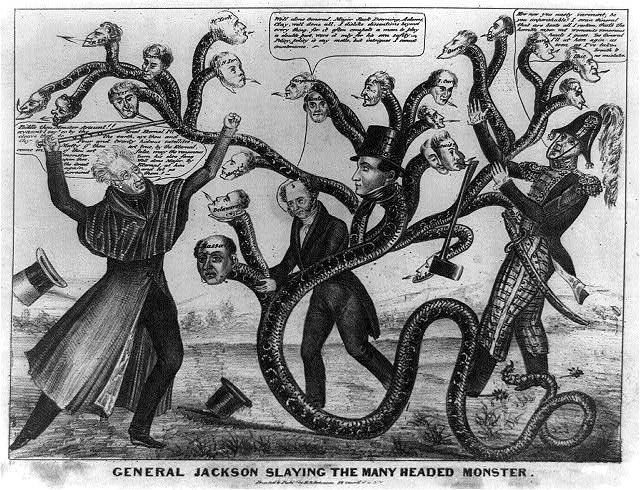
We take it for granted today that almost anyone over the age of 18 in America can vote, but at the time, this was not the case. Voting rights were based on land ownership, and many offices were determined by appointments rather than elections. But of course, America was supposed to be a country of freedom and democracy, and soon people agreed that it didn't make sense for a nation that espoused these values to prohibit someone from voting just because of their social standing. As time passed, voting rights were slowly expanded to include more and more people. And as this happened, the strategies that lead politicians to victories and elections had to evolve. Soon, someone rose up who would completely change the nature of American politics.
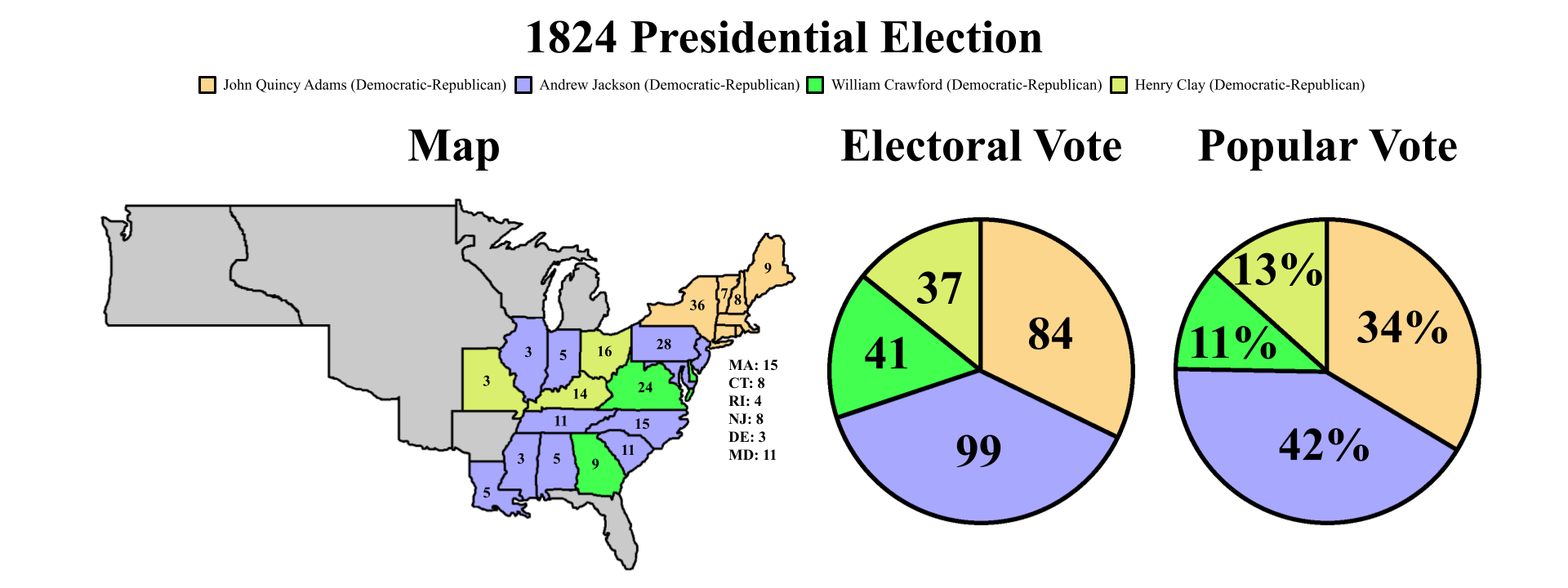
The election of 1824 was one of the most interesting in American history. Although Andrew Jackson got the most popular and electoral votes, he did not reach an electoral college majority, forcing the House of Representatives to step in to decide the race. Unfortunately for Jackson, the House of Representatives would instead pick John Quincy Adams. Four years later, Jackson returned with a vengeance.
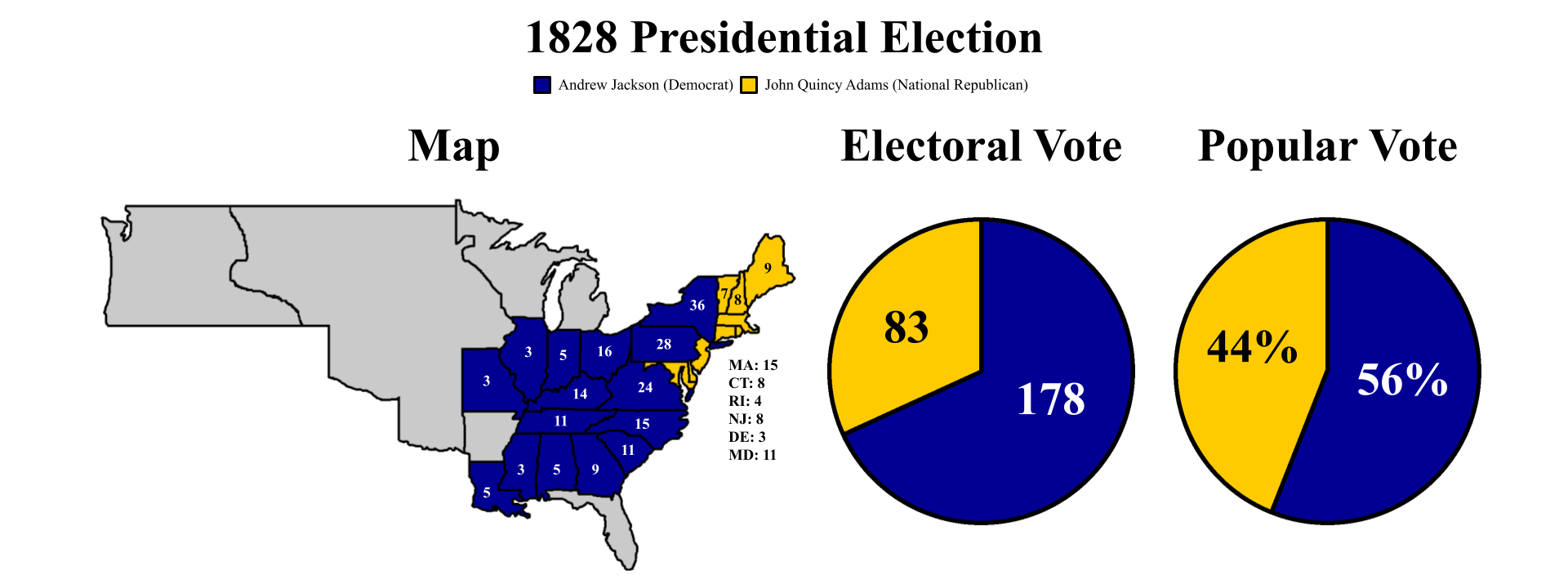
By 1828, the old party system had fallen apart, and both presidential candidates were members of new parties. Jackson joined the Democrats, whereas John Quincy Adams joined the National Republicans (which is not the same as the modern Republican Party). This time around, Jackson won in an electoral college landslide in addition to winning the popular vote once again. The genius of Jackson's campaign was that it specifically targeted people who couldn't vote before. He identified himself with the common man, and he used that to win the support of the masses. Of course, none of this was reflected in Jackson's policies. He didn't target the rich or big business in any major way. But despite all of this, he managed to convince the lower classes that he represented them better than John Quincy Adams.
Jackson's victory marked a fundamental change in American politics. It wasn't enough to just appeal to the wealthy. Politicians had to appeal to the masses. And although Jackson had numerous opponents, they failed to get the same level of support as him.
So where does Millard Fillmore come into this? Well, believe it or not, Millard Fillmore's introduction to politics didn't involve the Democrats or the National Republicans. The party he joined was a third party dedicated to the destruction of a fraternal organization. How could an entire political party be dedicated to something like that?
It all started in September of 1826. In Batavia, New York, there lived a struggling stonemason named William Mason. Trying to escape his crippling debts, Morgan wrote a book about the secrets of the ancient Masonic Order. Soon, Morgan was arrested, and despite being released quickly, he didn't return home. He was never seen again.
It wasn't long before people suspected that the Masons, wanting to protect their secrets, had kidnapped and murdered him. Everyone implicated was a Mason, and any judges, jurors, or sheriffs who were Masons seemed unwilling to accomplish anything. Things got worse when Morgan's book was finally published, and some of the oaths were wild. Anyone who wanted to join the order had to promise to help other Masons out if they were in trouble, even if they'd committed murder. Another oath said that if any Mason revealed the order's secrets, they had to be killed.
Despite attempts to punish the abductors, people never found out exactly what happened. People began to speculate that the Masons were a corrupt organization, controlling the United States government to protect their questionable goals. Many wanted to remove Masons from public office and even dissolve the organization.
One of the biggest proponents of Anti-Masonism was Thurlow Weed, an editor who wouldn't shut up about the story in his newspaper, the Rochester Anti-Masonic Enquirer. Weed did anything possible to incite hatred and distrust against the Masons, even getting aides to tell people in Western New York that Morgan's abductors had passed through their towns. In reality, Weed had ulterior motives.
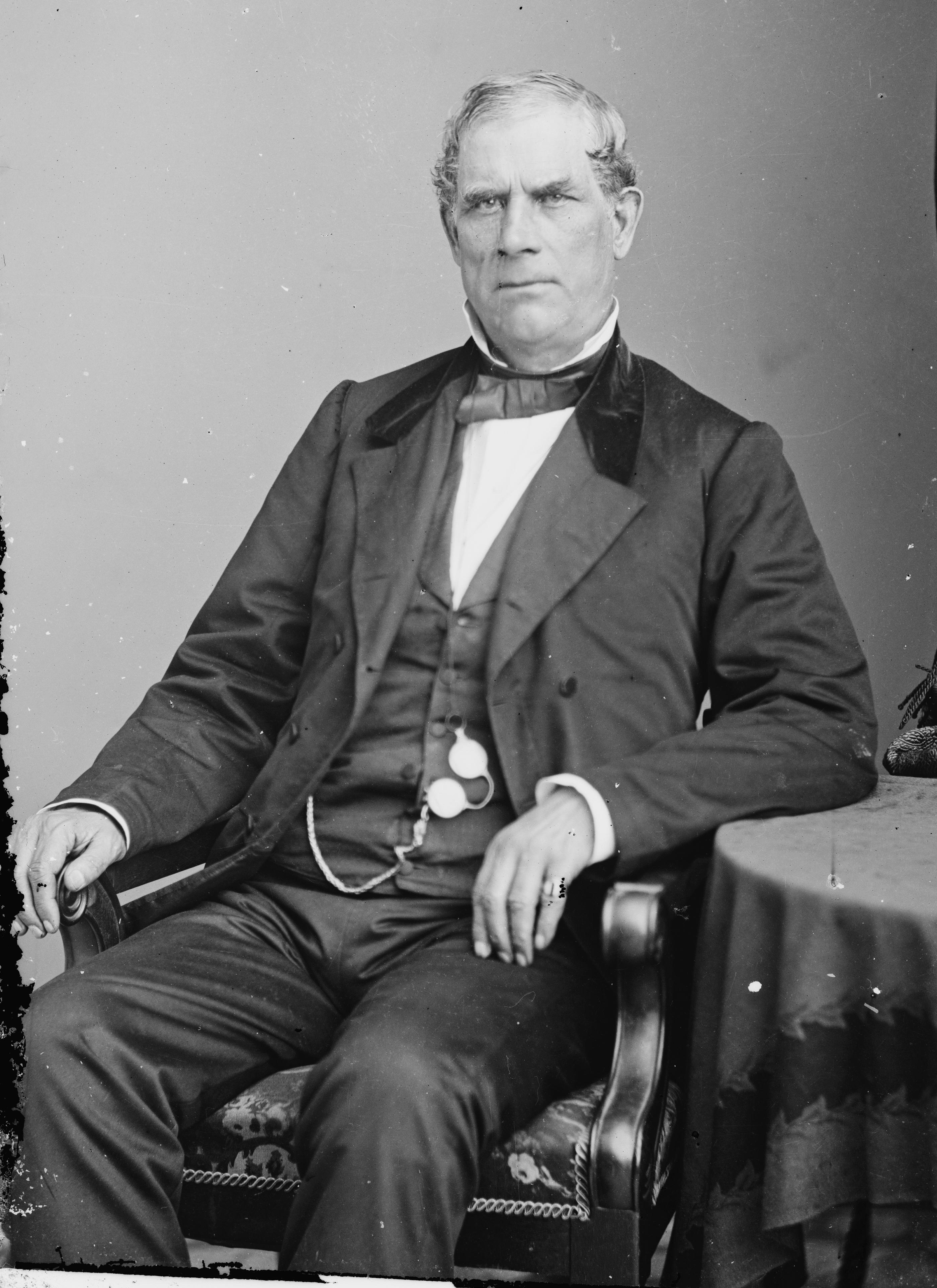
He was becoming influential in politics, which was rare for a newspaper editor at the time. What made him influential was the support of DeWitt Clinton, the governor of New York, and John Quincy Adams. Weed ended up helping John Quincy Adams out in a few ways. Most notably, when the 1824 election resulted in a deadlocked electoral college, Weed used his excellent manipulation skills to convince New York's legislators to give their state's vote to John Quincy Adams. But in 1828, he was in a dire situation.
It was in that year that DeWitt Clinton died in office. Even worse, John Quincy Adams' chances of being reelected were starting to seem very low in the face of Andrew Jackson's revolutionary campaign. Weed knew that if John Quincy Adams lost his power, he would meet the same fate. He had to find a way to ensure John Quincy Adams was reelected. And that's where Anti-Masonry came into play.
Weed's plan was to promote Anti-Masonry as much as possible, which would appeal to a lot of people. A new, Anti-Masonic Party would form, and it would have the appearance of being a third option separate from the Democrats or National Republicans. But eventually, Weed would make sure the new party nominated John Quincy Adams for president, increasing his chances of reelection. Effectively, the Anti-Masonic Party was a bait and switch. It would appeal to people as a third party on the surface, but in reality it promoted National Republicans. As strange as this may seem, the Anti-Masonic Party was gaining prominence quickly, and it soon had ⅛ of the seats in the New York legislature.
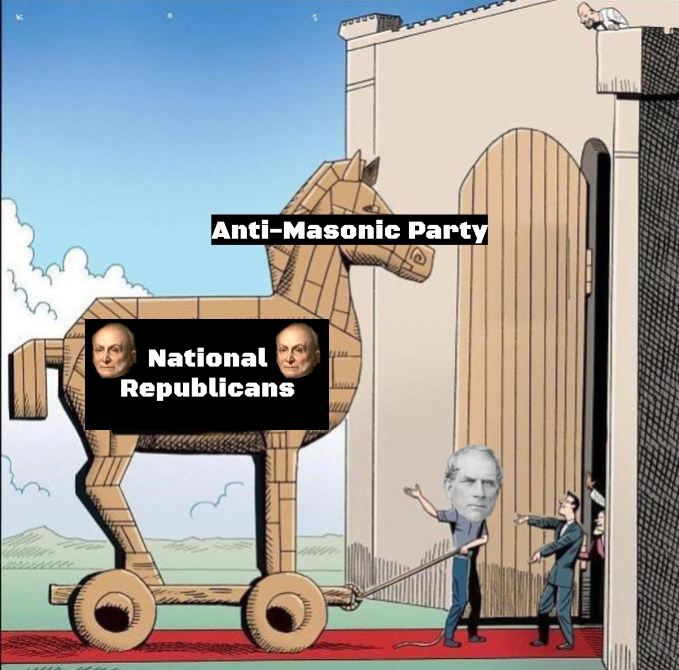
Unsurprisingly, Anti-Masonic sentiment reached Aurora, where Fillmore still resided. He wasn't that interested in politics in the past, but being an ambitious guy, he became involved in 1828, joining the Anti-Masonic Party. He attended some state conventions for the party and was beginning to get involved. But then Weed's plan fell apart.
As previously stated, Andrew Jackson won in 1828, defeating the alliance between Anti-Masons and National Republicans. And even worse, at a convention for the New York Anti-Masonic Party, the Anti-Masons ended up accepting John Quincy Adams for the presidential election, but for the New York gubernatorial elections, they chose a different candidate from the National Republicans. Unfortunately, this caused both the Anti-Masons and National Republicans to lose to Martin Van Buren, a Democrat.
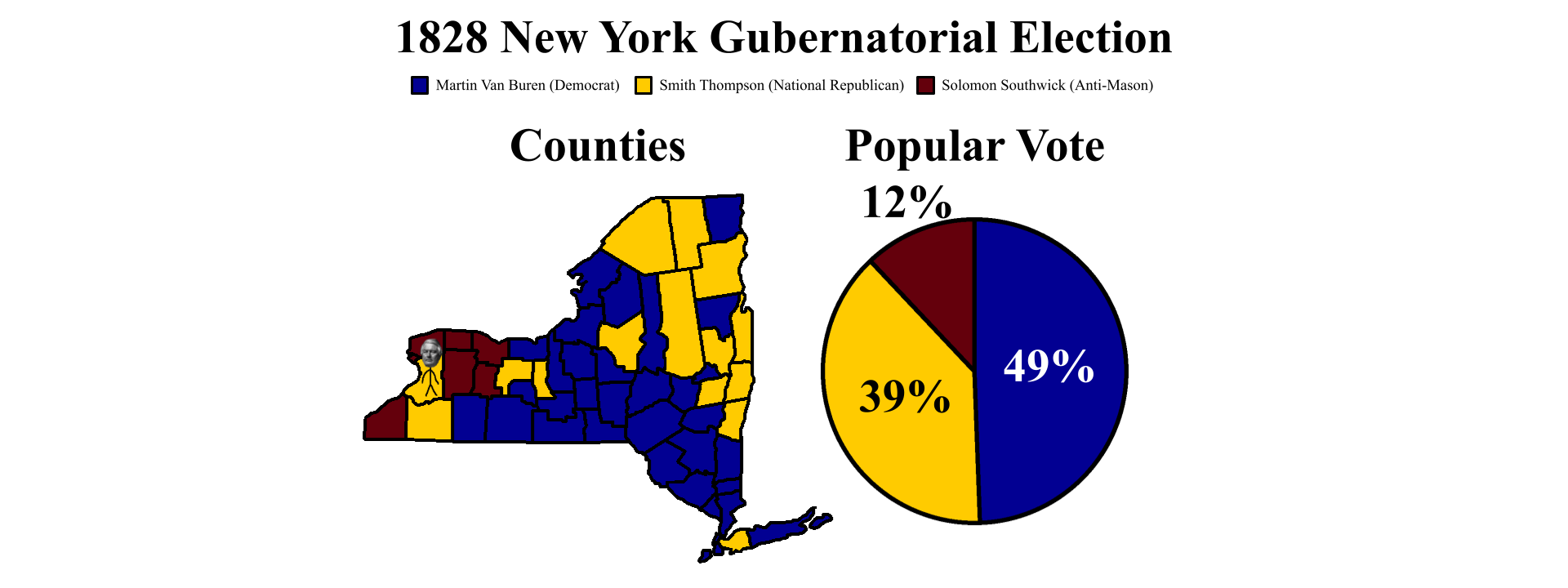
Despite this, it was not the end of politics for Fillmore or Weed. Erie County, where Fillmore lived, had still voted firmly against the Democrats, and soon Fillmore would become an Anti-Masonic candidate for New York state assembly. Still, the party was in a bad spot. Many National Republicans were now questioning their alliance. And even the National Republican party was starting to die out, as its leaders were simply ineffective at adapting to the changes of the modern era of politics.
To attempt to survive, the leaders of the Anti-Masonic Party started to think about what they'd done wrong. They realized that Anti-Masonry was never going to appeal to everyone, so they needed to deemphasize it and instead focus more on winning the underprivileged and attacking the Democrats. The party would not last much longer, but this plan gave Anti-Masons hope for the future. Fillmore ended up winning his race to get into the state assembly, and soon, he would become more and more influential over American politics.
Part 1 Part 3